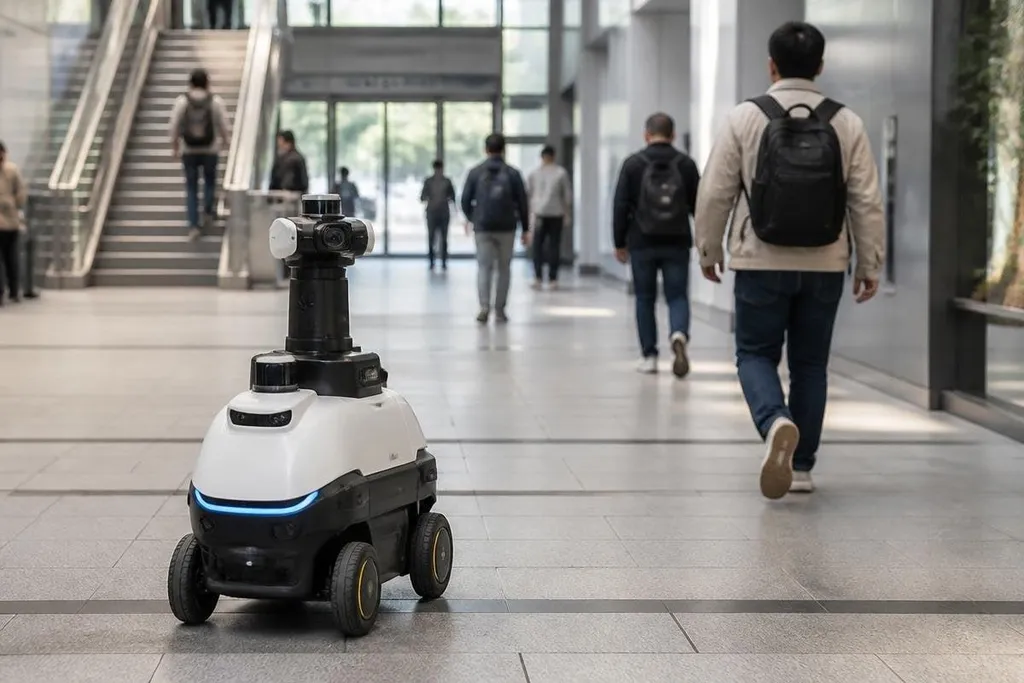
A surveillance robot can move through a station, campus, mall, or civic building while collecting video and sensor data. The hard part is deciding what that data means, who may access it, and when a person should act.
- Cameras record people, vehicles, doors, and objects in the robot’s path.
- LiDAR helps the robot map nearby space and avoid obstacles.
- Remote operators may review alerts or take control when the software cannot decide safely.
What these robots can see
Most surveillance robots begin with cameras. A wide-angle camera can watch the route ahead, while a second camera may record a closer view of doors, shelves, gates, or license plates.
That video can go to a control room, or the system can store parts of it for later review.
LiDAR adds distance data. It measures how far nearby surfaces are from the robot, helping the system build a map and move around people, walls, and furniture. This is different from video: a camera records appearance, while LiDAR measures shape and distance.
Some systems can also use thermal cameras, microphones, badge readers, or gas sensors. Each extra sensor changes the privacy question. A camera may record a face, while a microphone can record a conversation, and a thermal sensor can show heat patterns that people cannot see with their eyes.
Its route matters too. Geofencing creates a digital boundary that limits where it may travel. A system used inside a warehouse can follow a fixed route. One moving through a plaza has to deal with changing paths, crowds, bicycles, and people who stop without warning.
Alerts are not proof
Software can mark a person near a restricted door, an object left on the floor, or movement inside a closed area. That alert is a prompt for review. It isn’t proof that a crime, safety risk, or rule breach has occurred.
Facial recognition brings a separate problem. The system compares a face with a stored image or list, but lighting, camera angle, motion, and image quality can affect the result. A public-space operator needs a clear rule for what happens after a match, including who checks it and what record remains.
Remote control changes the setup again. A person may guide the robot around a blocked route, inspect a live video feed, or speak through a speaker. That person still needs training, access limits, and a record of actions taken during the shift.
A patrol robot can turn a public walkway into a place where cameras, audio, and location data are collected. Robot24 reporting can put those tools beside the robot’s stated task, operator role, and data rules. That evidence leads into the trade-off: what public-safety gain is worth the added record of daily life?
The public-space trade-off
A mobile robot can cover an area that is too large for one fixed camera. It can also move a sensor closer to an event instead of waiting for someone to notice a problem on a distant screen.
That mobility creates a wider record of daily life. The robot may pass people who have no reason to interact with it, including children, workers, visitors, and people using a building for a private appointment. Signs alone don’t answer how long the data stays stored or who can search it.
A sound policy should state the robot’s route, sensor types, recording rules, retention period, access list, and process for complaints. It should also explain whether the robot can identify people or only detect movement and objects.
The strongest opposing view is practical: public-space operators need tools that help staff respond to hazards and protect facilities. That case is reasonable when the robot’s task is narrow, its data use is visible, and a person reviews serious alerts.
A buying and policy checklist
Before a council, university, transit operator, or property manager buys a surveillance robot, check these points:
- Define the task: Write down the exact problem, such as checking a closed entrance or reporting a spill.
- List every sensor: Include cameras, microphones, LiDAR, thermal cameras, badge readers, and gas sensors.
- Set data limits: Decide what gets recorded, where it is stored, and when it is deleted.
- Keep human review: Require a person to check alerts before police contact, removal, or other serious action.
- Test failure cases: Run the robot near crowds, blocked paths, low light, reflective surfaces, and lost network connections.
- Publish a complaint route: Give the public a way to ask about recordings or report unsafe robot behavior.
What should happen next
Public-space robots will become easier to deploy as navigation, sensors, and remote control improve. The policy should move at the same pace: every new sensor needs a stated purpose, every alert needs human review, and every stored recording needs a deletion date.
I’d skip any system that cannot explain those three things before it starts recording.